Sustainable Fitness for Busy Men: Build Habits, Discipline, and Consistency
How to Build a Sustainable Fitness Program That Actually Fits a Busy Life
Most men don’t fail at fitness because they don’t care.
They fail because they’re trying to force discipline into a lifestyle that doesn’t support it.
They start strong.
They go all in.
They add too much at once.
Life gets chaotic.
They fall off.
And then they repeat the cycle.
If that sounds familiar, the problem isn’t your work ethic.
It’s that you’ve been taught to chase outcomes instead of building an identity and system that can survive real life.
This article breaks down how to build a sustainable fitness program using identity-based habits, flexible structure, and systems that adapt to busy schedules, not fight them.
Why Waiting for “The Right Time” Is Costing You More Than You Think
Everybody says “The time is now” and we all get that procrastination isn’t going to benefit us, but we often overlook how much it is actually costing us. Here’s why,
The longer you wait, the more deeply embedded you become in your current lifestyle.
Habits don’t stay neutral.
They compound.
When you procrastinate on fitness, it isn’t harmless. Over time your…
energy drops
confidence erodes
discipline weakens
beliefs harden (“this is just how I am now”)
It will never be easy.
But it will also never be easier than it is right now.
The goal isn’t perfection, it’s momentum. Momentum in the RIGHT direction.
Why Most Fitness Plans Fail (Even When the Goal Is Clear)
Most men believe results come from setting the right goal:
lose 20 lbs
train 5x/week
hit a 225lbs on bench
“get back in shape”
But goals don’t create results.
Systems do.
Yes, we still need goals as they give us direction and allow us to identify the right systems and habits we need.
Goals are the results you want. Systems are the processes that lead to those results.
Trying to achieve a new goal with the same broken system is why most programs fail. Not lack of discipline. Once we have a system in place it no longer serves us to focus on the goal. Our focus should primarily be on the system and habits.
If your system doesn’t fit your time, energy, and environment, it won’t last.
Identity-Based Habits: The Missing Link in Sustainable Fitness
At the core of long-term behavior change is identity.
Your habits are not random.
They are the outward expression of how you see yourself.
Fundamentally, our behaviors are the most outward expression of our innermost identity; our values, beliefs, and self-image.
That’s why:
habits aligned with your identity feel easy
habits that aren’t feel like chores
When someone says, “I just can’t stay consistent,” what they really mean is:
My habits don’t match who I believe I am.
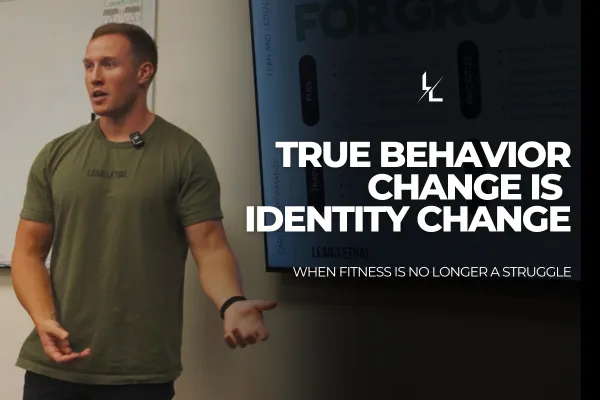
True behavior change happens when identity changes first.
Every Action Is a Vote for the Person You’re Becoming
The identity-based habit process is simple:
Decide the type of person you want to be
Prove it to yourself with small, repeatable actions
Every action you take is a vote for the person you want to become.
You don’t need massive change.
You need small wins that reinforce identity.
A man who trains twice a week consistently for a year will outperform the man who trains 6 days a week for three weeks and quits.
The Habit Loop: Why Willpower Fails Under Stress
Your habits exist to solve problems and conserve energy.
According to the Habit Loop framework:
Cue → trigger
Craving → desire for change
Response → behavior
Reward → relief or satisfaction
Habits reduce cognitive load and free up mental bandwidth, which is why they’re essential for busy men.
When fitness is automated through habits, it stops competing with work, family, and stress.
The 4 Laws That Control Behavior (And How to Use Them)
From the framework in the deck, behavior change is influenced by four levers :
Build Good Habits By:
Making them obvious
Making them attractive
Making them easy
Making them satisfying
Break Bad Habits By:
Making them invisible
Making them unattractive
Making them difficult
Making them unsatisfying
This is why your environment matters more than motivation.
If your environment supports the habit, discipline becomes optional.
Why Sustainable Fitness Is About Prioritizing Your Time and Energy, Not Adding More Hours
The deck emphasizes a critical truth:
This isn’t about finding more time. It’s about maximizing the time and energy you already have.
Most men don’t fail because they’re too busy, they fail because their best energy is being spent on tasks that don’t need it.
That’s why sustainable programs start with audits, not intensity.
The Lean & Lethal Habit Audit: Where Real Change Starts
The Habit Audit evaluates the structures that control your daily output:
protein consistency
sleep routine
stress response
frequent movement
hydration
morning routine
evening routine
alcohol intake
meal prep
weekly planning
Each habit either:
helps (+)
hurts (–)
This removes emotion and guesswork and replaces it with clarity.
How to Instantly Increase Energy Without More Gym Time
The deck outlines simple levers that can increase energy by 20–40% almost immediately :
10 minutes of morning sunlight
+20g protein at breakfast
10-minute walks after meals
2pm caffeine cutoff
phone off 90 minutes before bed
water before coffee
outdoor walks twice per week
5 minutes of mobility at night
These are not “fitness hacks.”
They are identity-reinforcing behaviors that make consistency possible.
Why Structure Is Freedom. Not Restriction.
The final theme of the presentation is structure.
Structure is not rigidity.
It’s what allows flexibility when life gets chaotic.
A clear identity, simple habits, and a supportive structure allow fitness to bend without breaking during travel, stress, or busy seasons.
Structure allows you to do more of what you want in the future by automating the present.
The Real Goal Isn’t Motivation, It’s Becoming the Type of Man Who Doesn’t Quit
Sustainable fitness isn’t about hype.
It’s not about perfect weeks.
It’s not about forcing discipline.
It’s about becoming the type of person for whom training, movement, and nutrition are simply what you do.
When identity leads, habits follow.
When habits follow, results take care of themselves.
If you want help building this kind of system, one that fits your life instead of fighting it, this is exactly the framework we teach inside the Lean & Lethal Project.
No extremes.
No perfection.
Just structure, identity, and consistency that actually lasts.


